Vai al contenuto


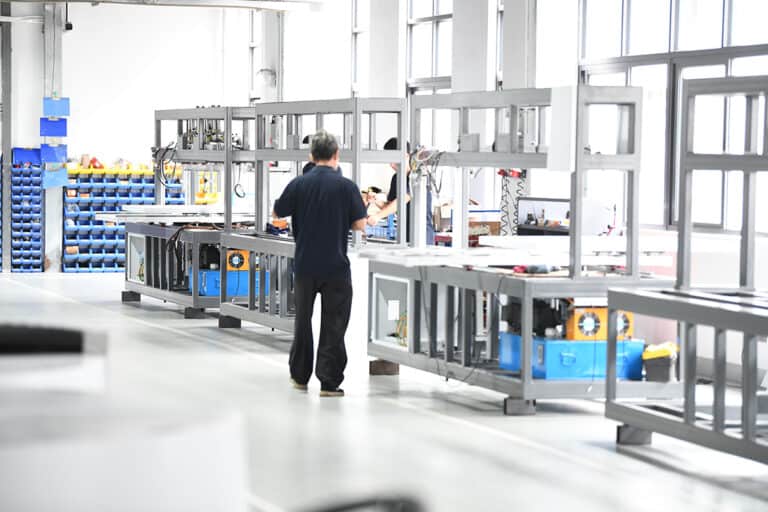










After die cutting, printed folding carton blanks are often not immediately ready for stable folder-gluer feeding because waste edges, internal waste pieces, loose nicks, uneven piles, or unstable blank separation can still remain in the stack.
If this intermediate step is not handled well, the folder gluer may slow down, stop frequently, misfeed blanks, or require extra operators to sort and prepare piles by hand.
Between a die cutter and a folder gluer, factories usually use a blanking or stripping machine to remove die-cut waste and separate printed folding carton blanks. Depending on the workflow, the line may also need inspection, stacking, or a buffer conveyor so the folder gluer receives clean, stable, and well-prepared blanks.
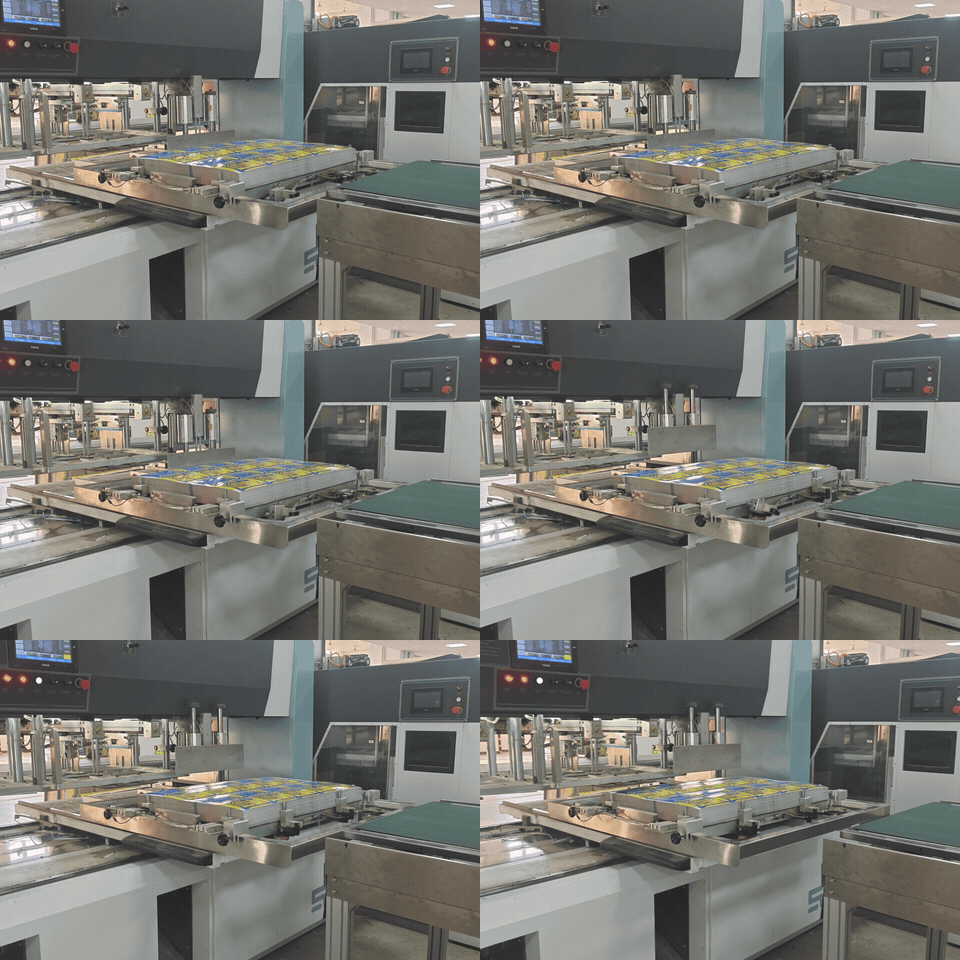
The right choice is not always one fixed machine; it depends on carton structure, die-cut layout, remaining waste, pile condition, order volume, and how sensitive the folder gluer is to feeding variation.
This article explains the practical equipment and process options between die cutting and folder gluing, and how a factory should judge what is actually needed.
What does a blanking or stripping machine do before folder gluing?
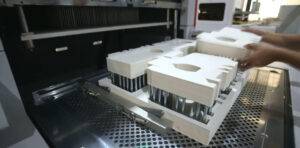
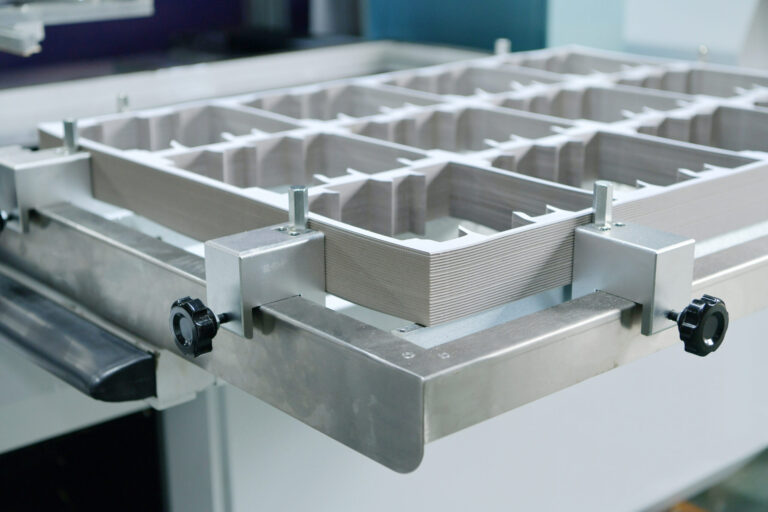
A blanking or stripping machine removes waste that remains after the printed sheet has been die cut. This may include outside waste edges, inner holes, small window waste, and parts held by nicks.
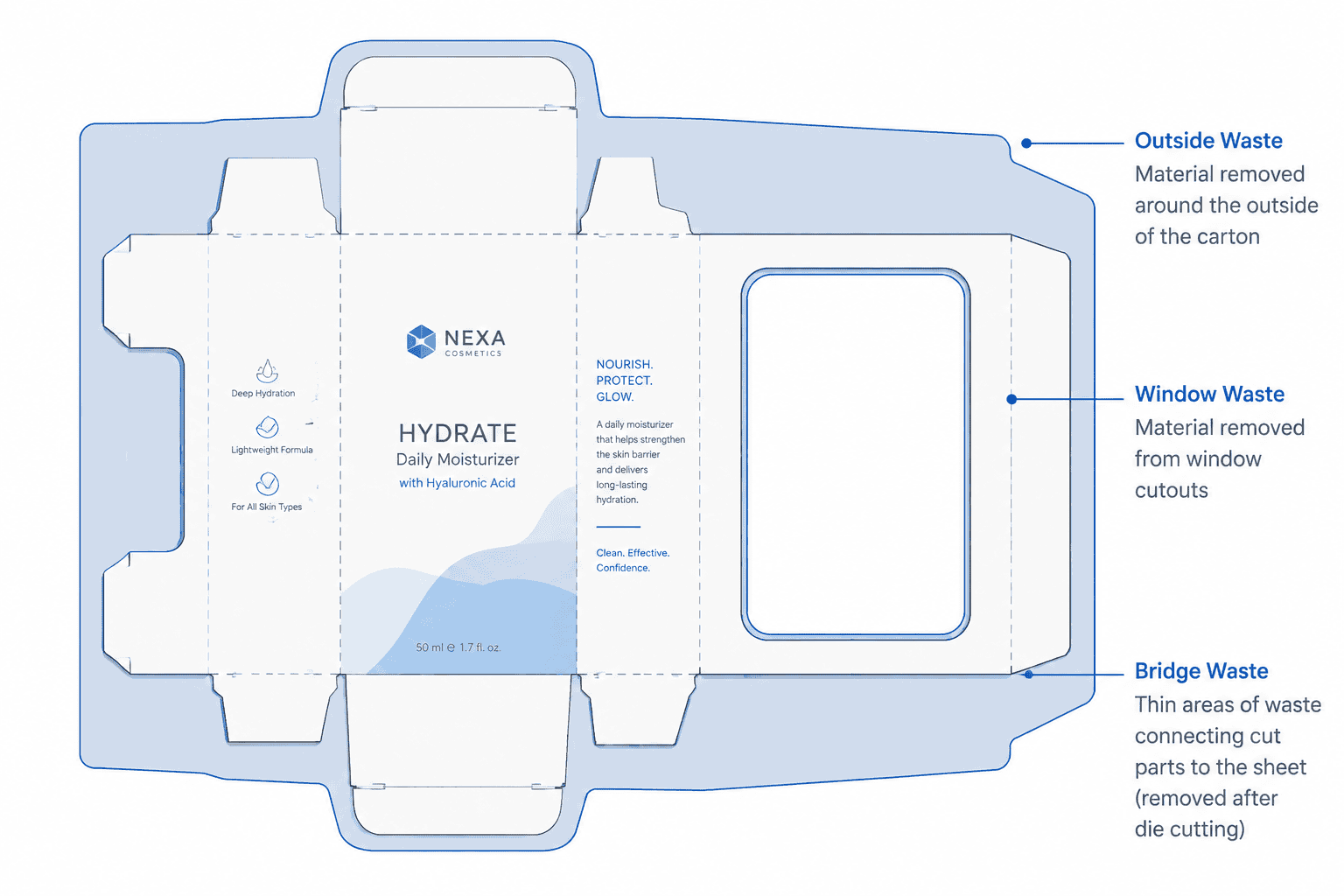
Its main job is to make the useful folding carton blanks separate cleanly from the waste area. This is important because the folder gluer does not like loose waste, half-broken nicks, or mixed blank positions in the pile.
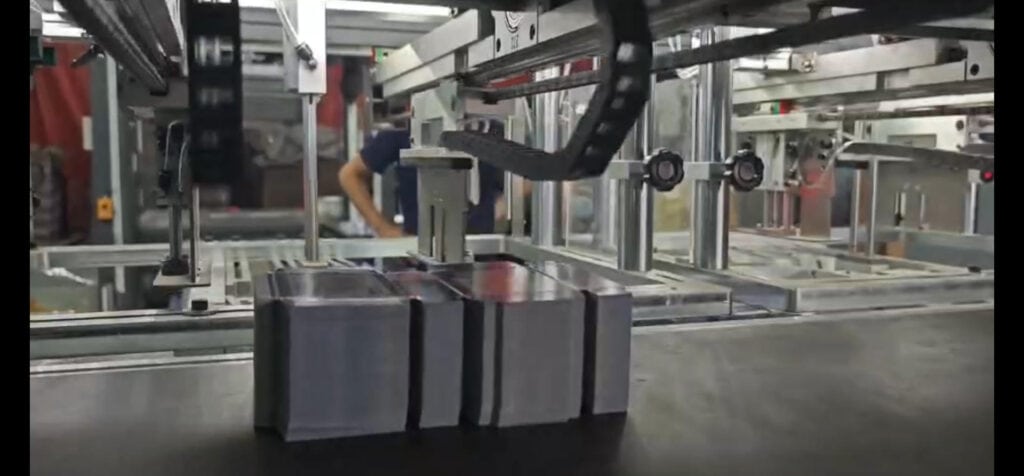
In many carton factories, this step is where production changes from a die-cut sheet into a stack of usable blanks. The output should be clean, flat, counted if needed, and easy for operators or feeders to load into the folder gluer.
The machine is not used for general carton waste or corrugated board waste stripping. In this article, the scope is printed folding carton sheets and post-press blank separation before folder gluing.
For buyers, the key point is simple. Do not only ask whether the die cutter can finish the cut. Ask whether the blanks after die cutting can feed smoothly into the next process.
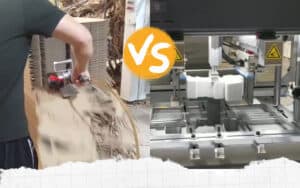
How do you choose manual or machine handling between a die cutter and a folder gluer?
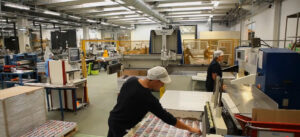
Manual handling can still work when the order is small, the carton shape is simple, the waste is easy to remove, and labor cost is acceptable. It also fits factories that change jobs very often and do not want long setup time for every short run.
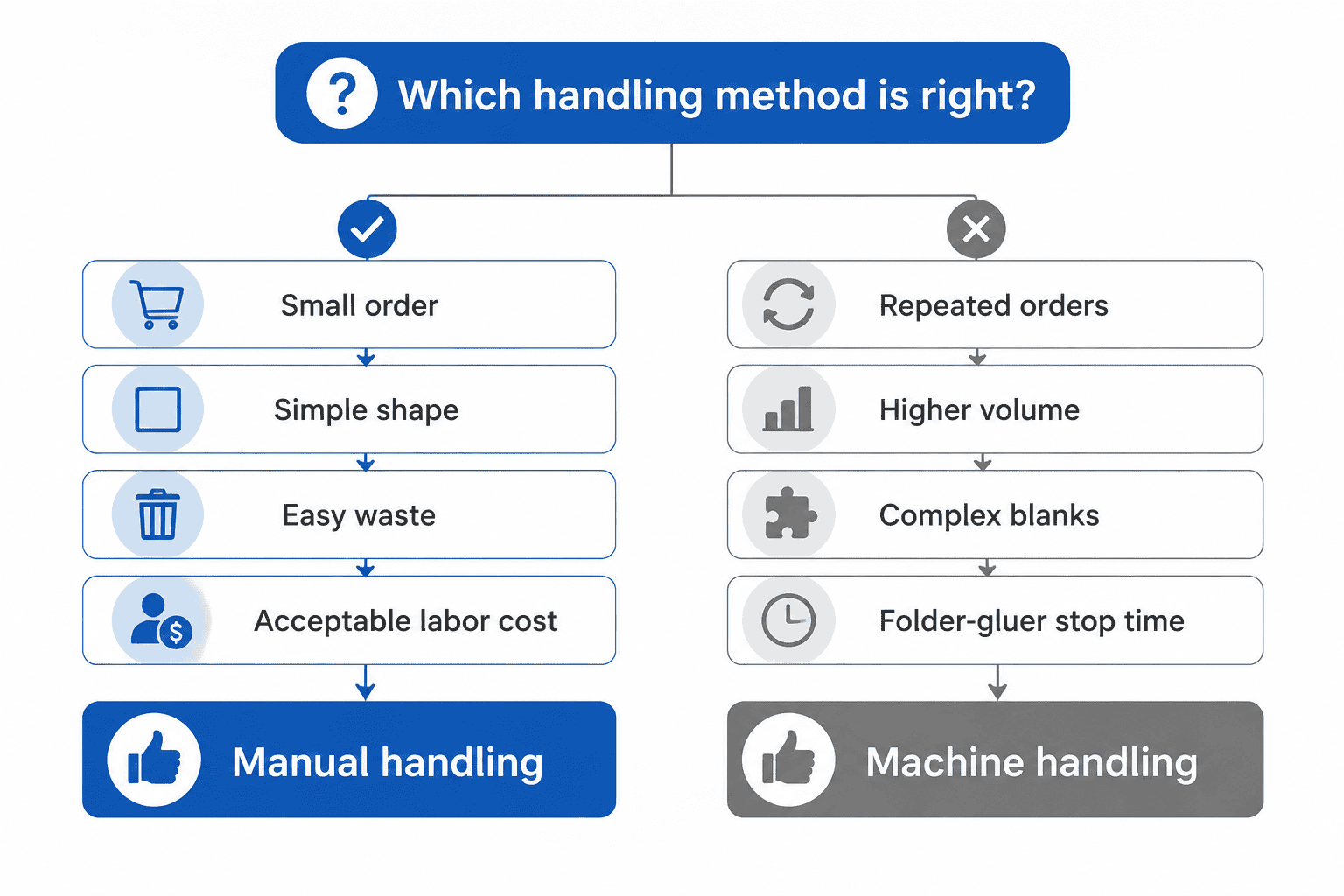
But manual work has limits. Operators may remove waste at different speeds. Piles may not be even. Some inner waste may remain. When the folder gluer runs faster than the manual preparation speed, the whole line becomes unstable.
Machine handling is usually better when orders are repeated, volume is higher, blank shape is more complex, or the folder gluer speed is being wasted by poor feeding preparation. It also helps when the factory wants more stable quality between shifts.
A practical buyer should compare three things: the labor used between die cutting and folder gluing, the stop time on the folder gluer, and the reject risk caused by poor blank separation.
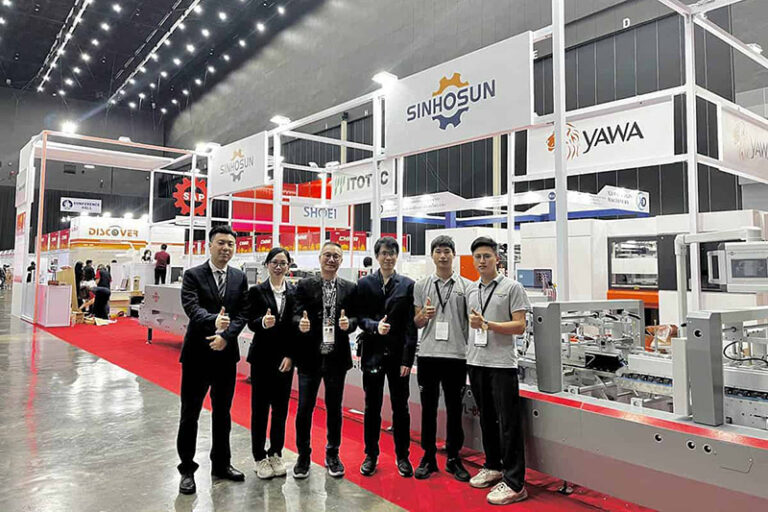
In SINHOSUN project discussions, we often see that the right answer is not only based on speed. It is based on how clean the blank stack must be before the folder gluer can run without constant operator correction.
Should blanking and stripping be inline with the die cutter or offline before the folder gluer?
Inline handling means the die cutting process and the waste removal or blank separation process are connected closely. This can reduce manual transfer and keep the process flow compact.
Inline systems are useful when the carton structure is stable, the production volume is high, and the factory wants fewer operators touching the sheets. They can also reduce pile movement and improve process control.
Offline handling means the die-cut stacks are moved to a separate blanking, stripping, inspection, or preparation station before folder gluing. This gives the factory more flexibility. Different jobs can be handled by different methods.
Offline systems are often easier for factories with many short orders, many carton sizes, or mixed job difficulty. They also allow the folder gluer to keep running while another job is being prepared.
The buyer should not choose inline or offline only by machine price. Check floor space, pile transfer method, job change time, operator skill, and how the folder gluer schedule is arranged.
Can stripping, feeding, and folder-gluer connection be fully automated?
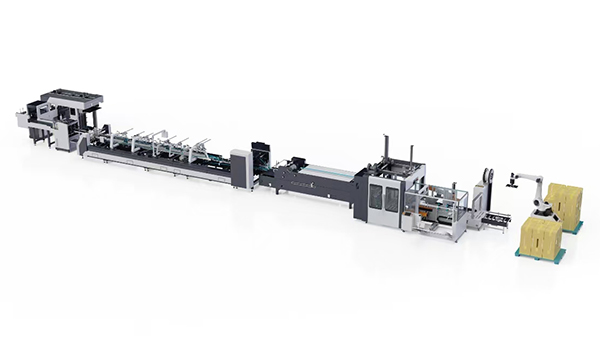
Some factories can build a highly automated flow. This may include automatic stripping or blanking, pile turning, counting, stacking, inspection, buffer conveying, and automatic feeding to the folder gluer.
Full automation works best when products are stable, order volume is large, and the factory has enough control over sheet quality, die cutting accuracy, and pile condition. The upstream and downstream equipment must match each other.
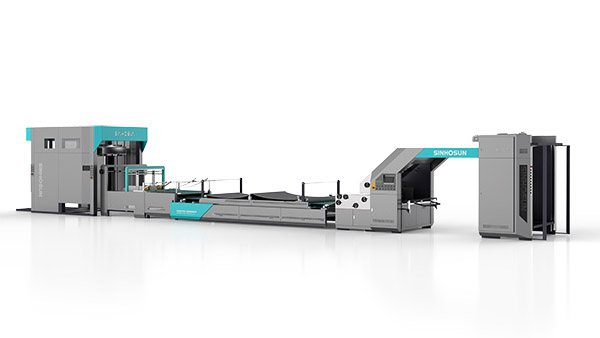
The SINHOSUN Fully Automatic Series offers a one-stop automation solution, handling the automated feeding, scrap removal, and paper collection of stacked sheets immediately after die-cutting. When paired with a conveyor belt and robotic palletizing module, it directly connects to the folding gluing machine for reloading, enabling the folding gluing process.
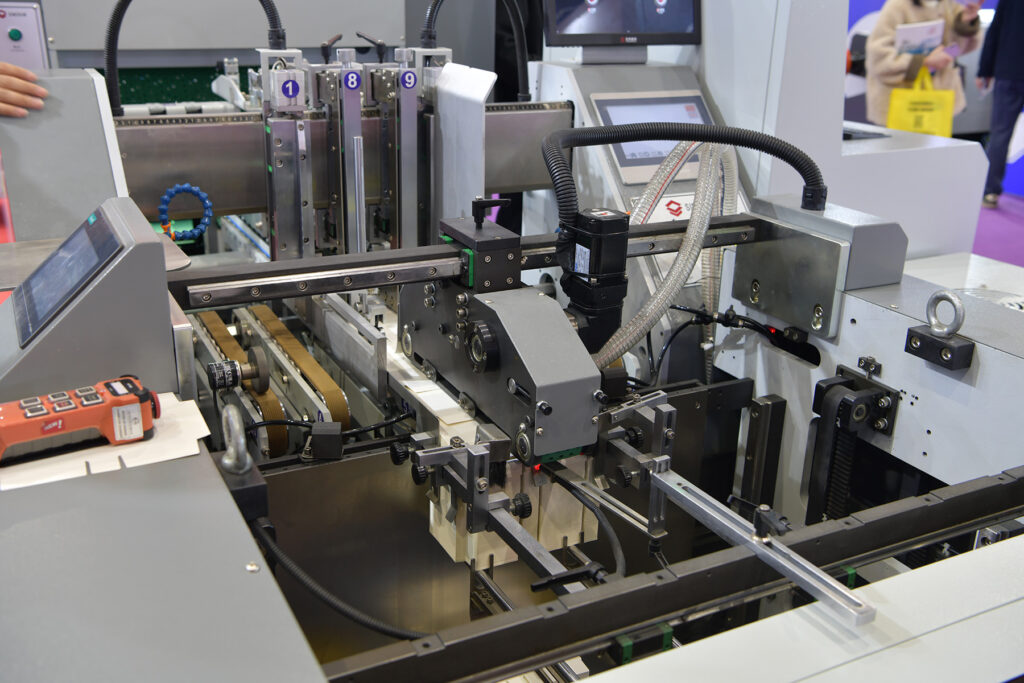
The practical question is not whether everything can be automated. The better question is which manual touch points create the most stops, waste, or labor pressure today.
What shows that die-cut blanks are ready for stable folder-gluer feeding?
Ready blanks should be clean. No loose waste should remain inside windows, slots, or small cut areas. Waste edges should not hang on the blanks.
The piles should be even and stable. If the stack leans, waves, or contains mixed positions, the feeder may pull double sheets, miss sheets, or feed at the wrong angle.
The nicks should be controlled. They must hold the sheet during die cutting but should not make blank separation difficult later. Poor nick control often creates hidden feeding problems.
Blank size and shape should be consistent. If die cutting pressure is uneven or sheets are deformed, the folder gluer may have trouble with register, folding, or glue position.
A good test is to watch the first feeding stage of the folder gluer. If operators keep tapping piles, removing waste, correcting skew, or slowing the machine, the blanks are not ready enough.
Conclusion
The equipment used between a die cutter and a folder gluer is usually a blanking or stripping machine for printed folding carton blanks. Depending on the factory workflow, inspection, stacking, buffering, counting, or feeding support may also be needed.
The correct choice depends on the real bottleneck. Some factories need only better manual preparation. Some need an offline blanking or stripping machine. Some need a more connected system to protect folder-gluer speed.
For buyers, the safest decision is to start from the condition of the blanks before feeding. If the blanks are clean, flat, separated, and stacked well, the folder gluer can do its job. If not, the missing process between die cutting and folder gluing must be improved.
SINHOSUN looks at this question from the post-press workflow side: not just which machine can be sold, but which step makes the next machine run steadily. That is the practical way to judge equipment between die cutting and folder gluing.